Ownership with intention starts before the search, before the pre-approval, before the first showing.September always feels different to me.It is the end of the third quarter. It is the last month

Dated: August 14 2026
Views: 275

A first home does not have to be the final home. It does not have to answer every prayer, solve every family goal, and carry the full weight of legacy on day one. It should matter. It should serve you. It should be something you can live with and, ideally, grow from. But it does not have to be the whole movie.
That is where buyers get tangled up. They are not only shopping for a house. They are shopping for certainty. They want the property to tell them that the next thirty years will work out. But real life does not move that cleanly. Jobs change. Families grow. Knees start talking. Parents age. Children need different things. Commutes shift. Income changes. Priorities mature.
A home can support your life. It cannot guarantee your life.
People call it being selective. Sometimes it is. Standards matter. Nobody should buy a house they cannot afford, cannot maintain, or cannot live in safely. But sometimes what we call “standards” is really fear dressed up in better shoes.
Fear says the first purchase has to be perfect. Intention says the first purchase has to be useful.
We already know affordability is a real issue. Housing costs are high. Interest rates have changed the math. Insurance, taxes, utilities, repairs, groceries, transportation, childcare, and debt are all competing for the same paycheck. A six-figure income does not stretch the way people imagined it would when housing takes such a large share of the monthly budget.
Pew Research Center reported in 2026 that 89 percent of adults under 40 say buying a home is harder for young adults today than it was for their parents’ generation. Pew also cited Federal Reserve survey data showing that 70 percent of renters under 40 say they rent instead of own because they cannot afford a down payment.
So no, this is not about pretending the market is easy. It is not.
But here is the part I want buyers to sit with: some people are not only priced out by the market. They are also expectationed out of the market.
They are trying to buy the house version of a life they have not built yet.
That does not mean their desire is wrong. Wanting comfort is not wrong. Wanting beauty is not wrong. Wanting efficiency, space, safety, and stability is not wrong. But when every desire becomes a requirement, the first home stops being a doorway and becomes a wall.
Before you shop for the dream, define the function.
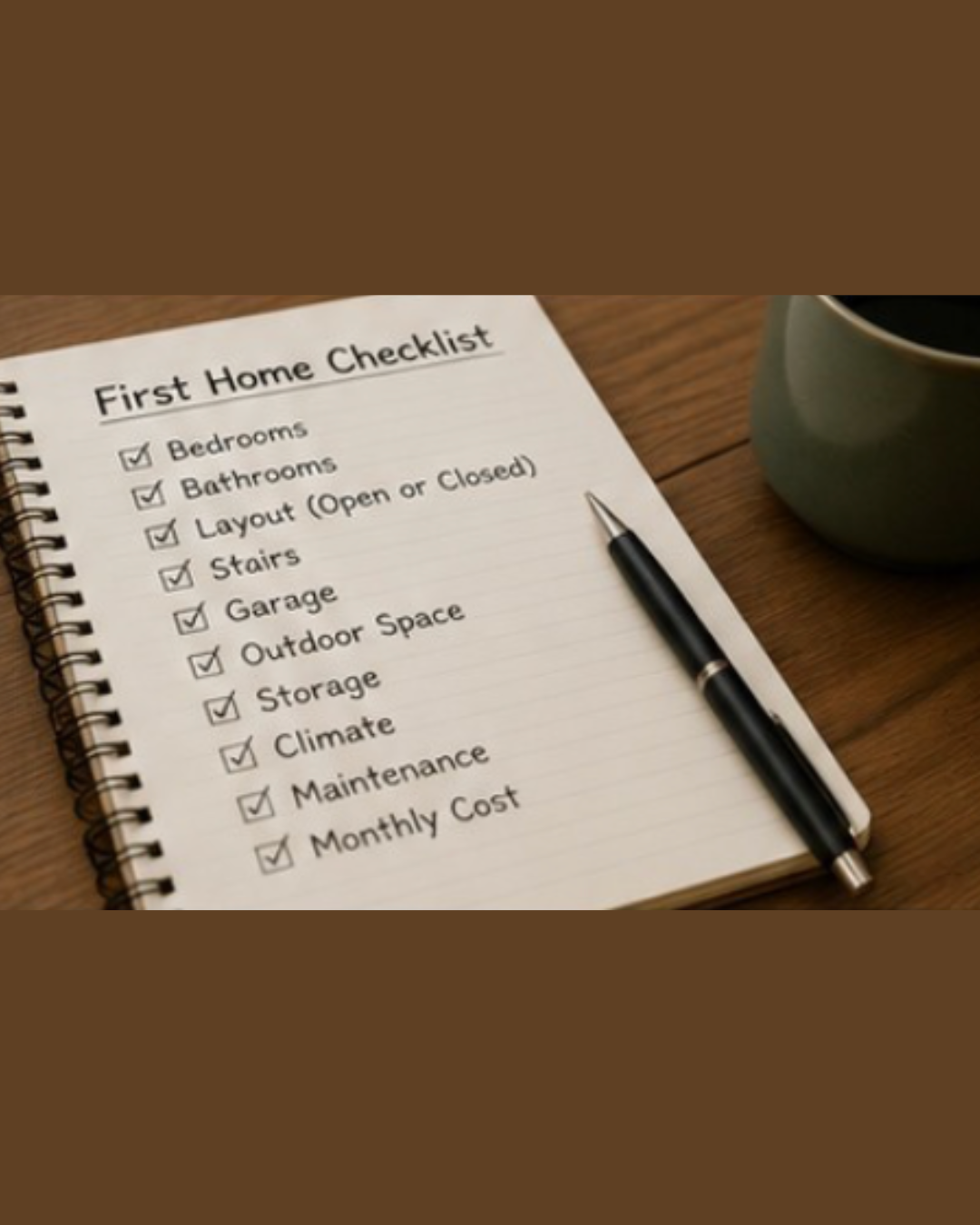
Function is not glamorous, but it is the part of the conversation that can save you from buying the wrong house or never buying at all. Function asks how you actually live, not how you think you are supposed to live once you have a new address.
How many bedrooms do you truly need to function? Not how many would be lovely. Not how many would impress guests. How many do you need for sleep, work, children, caregiving, privacy, or sanity?
How many bathrooms can your household live with? Some people need two full baths because of household size or morning routines. Some people want two full baths because they have been told every acceptable house must have them. Those are not the same thing.
Do you need open concept, or do you need doors? Open concept photographs beautifully. It gives light, flow, and togetherness. But some people do not want to walk through the front door and see every dish, shoe, backpack, toy, and Amazon box at once. That does not mean you are messy. It may mean your home is lived in, and your layout needs to respect that.
Do stairs matter? If you are buying your first home later in life, if you have aging parents, young children, bad knees, groceries, work bags, or a dog that refuses to cooperate, stairs are not a small detail. They are part of the daily experience of the house.
Does a garage matter in your climate? In some places, a garage is a convenience. In others, snow, rain, ice, darkness, safety, and carrying groceries from the car make parking feel much less optional. The question is not whether a garage is nice. The question is whether not having one will wear you down.
What kind of outdoor space do you actually need? A yard, a deck, a patio, a balcony, or access to a nearby park can all serve different lives. Be honest. Do you want outdoor space because you will use it, maintain it, and enjoy it? Or are you inheriting a Pinterest version of adulthood that does not match how you spend your Saturdays?
Is the house efficient, or just pretty? Buyers want newer systems, smart features, better windows, modern appliances, and lower-maintenance finishes. That makes sense. But efficiency costs money. Updates cost money. Newer homes cost money. The more bells and whistles you require, the more the price has to absorb.
This is why the basics matter. Bedrooms, bathrooms, layout, parking, stairs, outdoor space, commute, climate, storage, maintenance, and monthly cost are not boring details. They are the difference between a house you can actually live in and a house you only liked online.
Compromise has gotten a bad name, especially in a market where buyers already feel like they are giving up too much. But compromise is not the same as settling for anything. Compromise is the discipline of knowing which things carry your life and which things carry your ego.
A house can be smaller than your dream and still be smart. It can be older and still be solid. It can have a closed kitchen and still feed your family. It can have one less bathroom and still move you toward stability. It can lack the trendy finishes and still give you the first piece of ownership you need.
The question is not, “Does this house have everything?” The question is, “Does this house responsibly do what I need this season?”
This is the part too many people forget: ownership can be sequential.
The first home may create stability. The next decision may create more space. A later move may create income, flexibility, or legacy. That does not mean everyone should rush into a starter home or treat property like a game board. It means the first purchase does not have to carry the next thirty years by itself.
On average, life has a way of changing within a handful of years. Maybe the household grows. Maybe the job moves. Maybe a parent needs help. Maybe the children age into a different school need. Maybe you discover that the house you thought you wanted is not the way you actually live.
That is why buying with intention matters. You are not only buying a structure. You are buying a position. You are asking whether this property can help you live better now without blocking your next move.
That is a different question than, “Is this my forever home?”
It is also a more useful question.
Now let me be clear: this is not a push to buy anything just to say you bought something.
A first property should be useful, not desperate. If the payment is too tight, the repairs are too big, the location does not work, the stairs will become a problem, the commute will drain you, or the house only works if nothing goes wrong, then that is not intention. That is pressure in a mortgage-shaped costume.
There is wisdom in “not yet” when not yet protects your financial life.
But there is also a cost to waiting for a perfect property that keeps moving farther away while rents, prices, and expectations keep changing. Waiting can be strategy. Waiting can also become avoidance.
The work is knowing the difference.
Before you tour a single home, tell the truth about how you live.
Tell the truth about your money. Tell the truth about your habits. Tell the truth about what you clean, what you ignore, what you maintain, what you avoid, and what kind of space helps your household breathe.
Tell the truth about whether you need a yard or simply like the idea of one. Tell the truth about whether you need an office or whether a quiet corner will do. Tell the truth about whether you need a finished basement or whether you are chasing extra space because you are afraid the first house will not look successful enough.
Because that is often what is underneath it.
Buyers are not always just looking for shelter. They are looking for proof. Proof that they made the right choices. Proof that they are adults. Proof that the money was worth it. Proof that their family will be proud. Proof that their children will have more. Proof that they did not wait too long.
But a first home should not have to prove all of that.
It should serve the life you are actually living and support the next one you are building.
Stop asking your first home to be proof that you made it.
Ask whether it can help you move.
Move into stability. Move into ownership. Move into better control of your monthly housing cost. Move into a neighborhood that works for this season. Move into a property that gives you a responsible first step instead of a fantasy you cannot carry.
Your first home does not have to be the dream home, the forever home, the legacy property, and the generational wealth machine all at once.
Let the first home do the first job well.
Then keep building from there.

Lisa Hoover is a real estate broker associate with Douglas Realty who supports people across the real estate ecosystem in making thoughtful, well-timed decisions—whether they are preparing, repo....
Ownership with intention starts before the search, before the pre-approval, before the first showing.September always feels different to me.It is the end of the third quarter. It is the last month
A first home does not have to be the final home. It does not have to answer every prayer, solve every family goal, and carry the full weight of legacy on day one. It should matter. It should serve
Expectation Before AspirationSaturday nights in our house ran on cardboard money and plastic deeds. We played Monopoly until someone mortgaged Boardwalk, then reset the board and switched to The
There is a version of the housing market that a lot of people are still carrying around in their heads.A version with 3% mortgage rates. A version where homes seemed to appreciate almost by the.
 Copyright© 2026 REIN Inc. Information Deemed Reliable But Not Guaranteed. The listings data displayed on this medium comes in part from the Real Estate Information Network Inc.(REIN) and has been authorized by participating listing Broker Members of REIN for display. REIN's listings are based upon Data submitted by its Broker Members, and REIN therefore makes no representation or warranty regarding the accuracy of the Data. All users of REIN's listings database should confirm the accuracy of
the listing information directly with the listing agent. Copyright ©2026 REIN. REIN's listings Data and information is protected under federal copyright laws.Federal law prohibits, among other acts, the unauthorized copying or alteration of, or preparation of derivative works from, all or any part of copyrighted materials, including certain compilations of Data and information. COPYRIGHT VIOLATORS MAY BE SUBJECT TO SEVERE FINES AND PENALTIES
UNDER FEDERAL LAW.
REIN updates its listings on a daily basis. Data last updated: September 25, 2026 7:06 PM UTC
Show More...
Copyright© 2026 REIN Inc. Information Deemed Reliable But Not Guaranteed. The listings data displayed on this medium comes in part from the Real Estate Information Network Inc.(REIN) and has been authorized by participating listing Broker Members of REIN for display. REIN's listings are based upon Data submitted by its Broker Members, and REIN therefore makes no representation or warranty regarding the accuracy of the Data. All users of REIN's listings database should confirm the accuracy of
the listing information directly with the listing agent. Copyright ©2026 REIN. REIN's listings Data and information is protected under federal copyright laws.Federal law prohibits, among other acts, the unauthorized copying or alteration of, or preparation of derivative works from, all or any part of copyrighted materials, including certain compilations of Data and information. COPYRIGHT VIOLATORS MAY BE SUBJECT TO SEVERE FINES AND PENALTIES
UNDER FEDERAL LAW.
REIN updates its listings on a daily basis. Data last updated: September 25, 2026 7:06 PM UTC
Show More...
 All or a portion of the multiple listing information is provided by the Central Virginia Regional Multiple Listing Service, LLC, from a copyrighted compilation of listings. All CVR MLS information provided is deemed reliable but is not guaranteed accurate. The compilation of listings and each individual listing are ©2026 Central Virginia Regional Multiple Listing Service, LLC. All rights reserved.
All MLS listings are © 2026 Central Virginia Regional Multiple Listing Service, LLC. All
rights reserved. No one may copy and/or repost these MLS listings, or any portion thereof, without the written permission of an authorized officer of the Central Virginia Regional Multiple Listing Service, LLC.
All listings with the CVRMLS logo are provided courtesy of the IDX program.
Last Updated: September 25, 2026 7:30 PM UTC
Show More...
All or a portion of the multiple listing information is provided by the Central Virginia Regional Multiple Listing Service, LLC, from a copyrighted compilation of listings. All CVR MLS information provided is deemed reliable but is not guaranteed accurate. The compilation of listings and each individual listing are ©2026 Central Virginia Regional Multiple Listing Service, LLC. All rights reserved.
All MLS listings are © 2026 Central Virginia Regional Multiple Listing Service, LLC. All
rights reserved. No one may copy and/or repost these MLS listings, or any portion thereof, without the written permission of an authorized officer of the Central Virginia Regional Multiple Listing Service, LLC.
All listings with the CVRMLS logo are provided courtesy of the IDX program.
Last Updated: September 25, 2026 7:30 PM UTC
Show More...
 Copyright © MFRMLS.com All information deemed reliable but not guaranteed. All properties are subject to prior sale, change or withdrawal. Neither listing broker(s) or information provider(s) shall be responsible for any typographical errors, misinformation, misprints and shall be held totally harmless. Listing(s) information is provided for consumers personal, non-commercial use and may not be used for any purpose other than to identify prospective properties consumers may be interested in purchasing. Information on this site was last updated Last updated on September 25, 2026 7:27 PM UTC The listing information on this page last changed on Last updated on September 25, 2026 7:27 PM UTCd. The data relating to real estate for sale on this website comes in part from the Internet Data Exchange program of MFR MLS.
All information deemed reliable but not guaranteed. All properties are subject to prior sale, change or withdrawal. Neither listing broker(s) or information provider(s) shall be responsible for any typographical errors, misinformation, misprints and shall be held totally harmless. Listing(s) information is provided for consumers personal, non-commercial use and may not be used for any purpose other than to identify prospective properties consumers may be interested in purchasing.
Updated on September 25, 2026 7:27 PM UTC
Copyright © MFRMLS.com All information deemed reliable but not guaranteed. All properties are subject to prior sale, change or withdrawal. Neither listing broker(s) or information provider(s) shall be responsible for any typographical errors, misinformation, misprints and shall be held totally harmless. Listing(s) information is provided for consumers personal, non-commercial use and may not be used for any purpose other than to identify prospective properties consumers may be interested in purchasing. Information on this site was last updated Last updated on September 25, 2026 7:27 PM UTC The listing information on this page last changed on Last updated on September 25, 2026 7:27 PM UTCd. The data relating to real estate for sale on this website comes in part from the Internet Data Exchange program of MFR MLS.
All information deemed reliable but not guaranteed. All properties are subject to prior sale, change or withdrawal. Neither listing broker(s) or information provider(s) shall be responsible for any typographical errors, misinformation, misprints and shall be held totally harmless. Listing(s) information is provided for consumers personal, non-commercial use and may not be used for any purpose other than to identify prospective properties consumers may be interested in purchasing.
Updated on September 25, 2026 7:27 PM UTC
33. Required DMCA Notice
The Digital Millennium Copyright Act of 1998, 17 U.S.C. §512, the DMCA, provides recourse for copyright owners who believe that material appearing on the Internet infringes their rights under U.S. copyright law. If you believe in good faith that any content or material made available in connection with our website or services infringes your copyright, you (or your agent) may send us a notice requesting that the content or material be removed, or access to it blocked. Notices must be sent in writing by email to DMCAnotice@MLSGrid.com. The DMCA requires that your notice of alleged copyright infringement include the following information: (1) description of the copyrighted work that is the subject of claimed infringement; (2) description of the alleged infringing content and information sufficient to permit us to locate the content; (3) contact information for you, including your address, telephone number and email address; (4) a statement by you that you have a good faith belief that the content in the manner complained of is not authorized by the copyright owner, or its agent, or by the operation of any law; (5) a statement by you, signed under penalty of perjury, that the information in the notification is accurate and that you have the authority to enforce the copyrights that are claimed to be infringed; and (6) a physical or electronic signature of the copyright owner or a person authorized to act on the copyright owners behalf. Failure to include all of the above information may result in the delay of the processing of your complaint.
 © BRIGHT, All Rights Reserved
Information Deemed Reliable But Not Guaranteed
The data relating to real estate for sale on this website appears in part through the BRIGHT Internet Data Exchange program, a voluntary cooperative exchange of
property listing data between licensed real estate brokerage firms in which
participates, and is provided by BRIGHT through a licensing agreement.
The information provided by this website is for the personal,
non-commercial use of consumers and may not be used for any purpose other than to identify prospective properties consumers may be interested in purchasing.
Data last updated: September 25, 2026 4:14 PM UTC
Some properties which appear for sale on this website may no longer be available
because they are under contract, have Closed or are no longer being offered for sale.
Some real estate firms do not participate in IDX and their listings do not appear on this website. Some properties listed with participating firms do not appear on this website at the request of the seller.
Show More...
 All or a portion of the multiple listing information is provided by the Williamsburg Multiple Listing Service, LLC, from a copyrighted compilation of listings. All WMLS information provided is deemed reliable but is not guaranteed accurate. The compilation of listings and each individual listing are ©2026 Central Virginia Regional Multiple Listing Service, LLC. All rights reserved.
All MLS listings are © 2026 Williamsburg Multiple Listing Service, LLC. All rights reserved. No one may copy and/or repost these MLS listings, or any portion thereof, without the written permission of an authorized officer of the Williamsburg Multiple Listing Service, LLC.
All listings with the WMLS logo are provided courtesy of the IDX program.
Last Updated: September 25, 2026 7:27 PM UTC
All or a portion of the multiple listing information is provided by the Williamsburg Multiple Listing Service, LLC, from a copyrighted compilation of listings. All WMLS information provided is deemed reliable but is not guaranteed accurate. The compilation of listings and each individual listing are ©2026 Central Virginia Regional Multiple Listing Service, LLC. All rights reserved.
All MLS listings are © 2026 Williamsburg Multiple Listing Service, LLC. All rights reserved. No one may copy and/or repost these MLS listings, or any portion thereof, without the written permission of an authorized officer of the Williamsburg Multiple Listing Service, LLC.
All listings with the WMLS logo are provided courtesy of the IDX program.
Last Updated: September 25, 2026 7:27 PM UTC
